Showing posts with label Detroit I: N.Doulos/J. Evangelista. Show all posts

10.18.2011

Translation Station #4: Kanaleneiland Event

As a follow-up of their previous three translation stations, all based on their experiences in Detroit, Nikos Doulos and João Evangelista presented their fourth and last one that this time takes place in de Utrecht area of Kanaleneiland. The translation stations are stops in the process in which experiences and knowledge that are obtained in Detroit, are tested in a new context. Expodium instructs the artists it sends to Detroit to physically get their hands dirty and realise projects that are entrenched in the urban situation in Detroit. This method is used in Kanaleneiland as well. That’s why Translation Station #4 focused on finding an appropriate way of applying knowledge that is obtained in Detroit, to the social context of Kanaleneiland.

Nikos got in contact with newcomers in the area during his stay: artists that have come to live in the area and found themselves confronted with the fact that they have to do ‘something’ in the area. The urge or capability however to act collectively is practically non-existent, as Nikos found out. His contribution to this evening thus existed of a performative presentation and slide show entitled ARE YOU PEOPLE?, in which he, together with Mai Linh Ly and Koen Marks (both living in Kanaleneiland), explained why collective feeling doesn’t emerge, what does make it emerge and what their actions were, based on the findings of Nikos. The action that came out of their experiences during last month is the so-called NIGHT WALKERS.

NIGHT WALKERS is a group of artists and inhabitants of Kanaleneiland. They carry out hikes at night in order to, collectively, explore new peculiarities in the area. On this evening too, a night walk took place with a focus on ‘spaces of tranquility’ in the area. The route took us to the promenade along the Amsterdam-Rijn canal, via the Sayidina Ibrahim mosque to the St. Antonius hospital and to the Eyüp Sultan mosque.

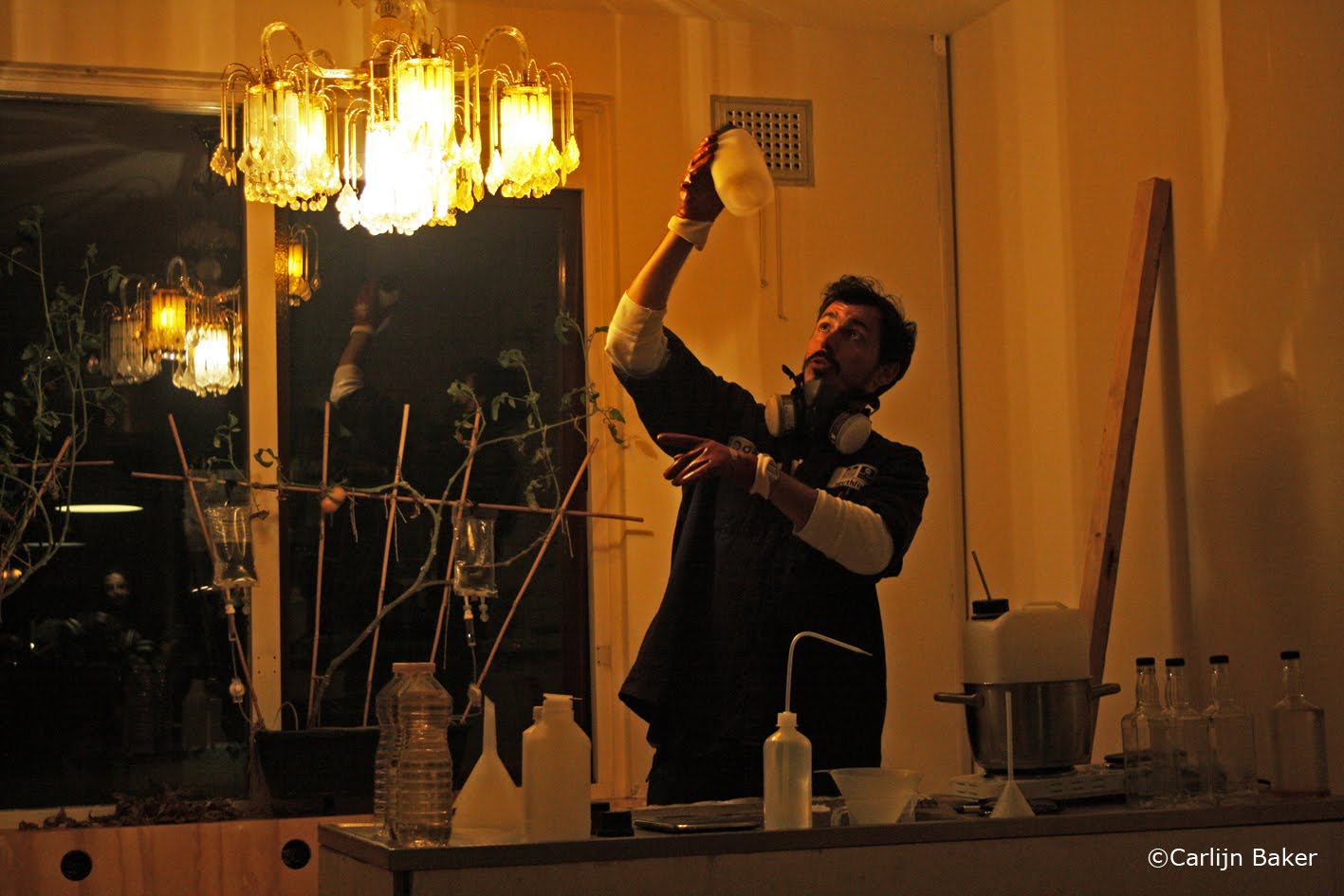
João Evangelista presented a service-project SERVICE LAUNCH - from which he will try to instigate a collective response. Based on his knowledge obtained in Detroit about producing bio-diesel, he gave a ‘cooking work shop’. João constructed a bio-diesel lab in the apartment to give a demonstration on how to make bio-diesel. The presentation was filled with references to power relations, political tendencies and alternative economies. During stirring the mixture of methanol, hydroxide and vegetable oil, which took about twenty minutes, the audience could ask questions.
With his service João focuses on the community of vintage Mercedes owners. Within that bunch, there is already some interest in the bio-diesel lab. The upcoming period, João will pass the knowledge about bio-diesel production on to inhabitants of Kanaleneiland in order to create a collective around the lab. The lab is made mobile in order for it to travel with the inhabitants who are interested in continuing it.

Both presentations of the projects are moments in the trajectory of locatie:KANALENEILAND. The upcoming weeks both NIGHT WALKERS as the bio-diesel lab will be continued.

10.14.2011

Translation Station #4

15.10.2011 | 20.00-23.00 | locatie:KANALENEILAND (Auriollaan 98)
João Evangelista | Nikos Doulos

As a follow-up of our three previous translation stations, all based on our Detroit experiences, We present the fourth and final translation station, this time in Kanaleneiland, Utrecht.

The translation stations are stops in the process of testing experiences and knowledge learned in Detroit, against different contexts. As Expodium assigns the artists they send to Detroit to get their hands dirty in order to come up with projects that root in the urban situation there, this method is also applied to Kanaleneiland. Therefore, Translation Station #4 focuses on finding an appropriate way of applying the knowledge gained in Detroit to the social context of Kanaleneiland.

João Evangelista | SERVICE LAUNCH 1& 2
15.00 (SERVICE LAUNCH 1) | 21.00 (SERVICE LAUNCH 2)

What proverbial power lies dorment in a neighborhood like Kanaleneiland? What groups of people already have their own productive way of looking after their own? João Evangelista will be showing a straightforward way of producing power, kick-starting a communal way of working on a shared interest.


Nikos Doulos | ARE YOU PEOPLE?
with Mai Linh Ly & Koen Marks 20.00
Nikos Doulos' performance is rooted in collecting information obtained while taking baby steps towards a collective doing. During his stay in Kanaleneiland this last month, he hooked up with many local artists and initiatives and tested several ways of operating as a collective, focusing on the 'why' rather than the 'know how' of such an activity. The emphasis was put on its necessity as a format for doing and creating a sense of 'belonging to' instead of it being a top-down initiative.


And of course one more NIGHT WALKERS session!

NIGHT WALKERS #4
22.00

NIGHT WALKERS is a group of artists and residents in Kanaleneiland, Utrecht.
They initiate night walks around the area.
Meeting point: Front porch at Auriollaan 98!

Join NIGHT WALKERS and:
allow yourself to get affected by the urban night-scape.

9.09.2011

Clearly not all about Detroit


It's been 380 days since we left Detroit. And by we I mean Joao and me.
It's been 24 days since they left Detroit. And by they I mean Jonas and Chris.
It is quite evident that our focus on the city differed and while our translation process is coming to an end, theirs has just begun.

We embrace the uniqueness of the moment and feel the need to reflect upon, not so as to give an elaborate view on the effect Detroit had on all of us, but to investigate the nature of the 'residency', the failures and successes of any translation attempt, and the identity of the 'artist in residency' - who ever this body and mind is or has become.

Therefore we would like to invite everyone to an event on Friday the 16th in the Kanaleneiland apartment of Expodium, in Utrecht.
Following up is the press release! Have a look and drop by!


Two artists that have been building on their experiences from a residency period in Detroit (that's me and Joao) encounter two artists that have just returned from that same city (that's Jonas and Chris). A unique confrontation that will leave you pumping with energy for new plans.

During the night you will see some work-in-progress, an innovative publication project, provoking political presentations and much more. Everything stems from the possibilities the Detroit program offers to be used for an extensive period and on multiple locations, in a constructive way.

The four artists take you along locatie:KANALENEILAND and open your eyes towards possibilities that come into existence when you apply your experiences to a new context.

After all these insights we'll get a party going on the tunes of DJ Lonely and Baba Electronica.

A brief preview:
Michigan left
by Chris Meighan

Electro lecture
by Jonas Ohlsson

Launch of the DBA_IDURLL* publication project
Nikos Doulos | João Evangelista
* DETROIT: BACK TO THE FUTURE/ARCHIVE OF IMPRESSIONS between illusion and delusion, urban and rural, living and leaving

1.28.2011

DETROIT: THE PUBLICATION


Bart and Luc are heading to Detroit to visit the "dream-team".
They will be carrying in their luggage the ARCHIVE OF IMPRESSIONS exhibition package as well as our recently produced Detroit publication.

"DETROIT: BACK TO THE FUTUREARCHIVE OF IMPRESSIONS - between illusion and delusion, Urban and Rural, living and leaving" is a 179 pages booklet, printed in a limited edition of 30 copies. Every copy is numbered and signed.
Around 10 of them will be distributed to the organizations and initiatives we have been collaborating with and 20 copies will be circulated to a expanded network of professionals as part of the Urban Translations project  .

This publication is designed to give an inside to our journey so far. It includes part of the Visual Archive, a series of texts as well as documentation photos and descriptive articles of all three stations of the Translation Process.


Unlike most booklets "DETROIT: BACK TO THE FUTUREARCHIVE OF IMPRESSIONS" avoids a linear order. A plastic screw on the top left side binds all pages together, inviting readers to "twist" instead of "flip", suggesting various starting points.

"This publication is set to give a mere impression of Detroit’s complexity and highlight notions, embedded within its current state. Notions such as mutualism and the sense of taking care, preservation and the sense of belonging, agency, necessity and the trust in the outcome of a creative mind......As artists interested in social phenomena, we research, documentate and mediate. We “engage” with our subject matter, put trust in our practice, our background knowledge and reflective skills.
But so do architects, philosophers, sociologists and journalists.

We have often wondered what separates us from any other researcher.

This publication is set to give an answer to that and establish a more concrete perception of our status during our sixty-four days residency in Detroit.

Cultural colonizers? Accidental tourists? Parachuted maggots? Temporal residents or all of the above? "
Abstract from the publication's introductory text.


p. 178.

10.20.2010

Translation Process #2: Impakt Performance


Nikos Doulos Joao Evangelista
17.10.10 17:00 bus departure at Theater Kikker
( limited capacity)

Expodium’s participation in the Impakt Festival was a commissioned, progress-based work on ‘shrinking cities and emerging strategies’, carried out in a collaboration with the artists Nikos Doulos (Greece) and João Evangelista (Portugal) during a period of 64 days in Detroit.

The event revolved around the traces and marks left on the artists during their residency by means of a modular narrative in stations. Spectators were encouraged to envision the urban landscape in a process of arrivals and departures, an archive of impressions and stories.

An old American school bus took the audience out of the center of Utrecht to Hofstede, a preserved monument - farm, built next to the upcoming center of Leidsche Rijn.


First stop took place at Expodium, where people got confronted with the Visual Archive and were given twenty minutes to dive into it.
The visit to the farm consisted of scripted narratives performed on predefined locations/stations.


The discontinuity in the form of our narratives, shifting from here (Leidsche Rijn) to there (Detroit) and vice versa, served the purpose of highlighting the bypolarity in the co-existence of the urban and the rural, growth and shrinkage, Detroit and the Netherlands. What became of great importance to us was pointing out the need for a collective creative response towards the transitional nature of contemporary urban surroundings.

The city doesn't need artists. it needs persons who can respond creatively to life.
Erin Moran Martinez


first page of the tour script after rehearsal in the rain.

10.13.2010

contribution to Filter-Detroit


FILTER DETROIT is the little sister of FILTER; a platform for international contemporary art and culture.
FILTER DETROIT researches structural and cultural processes of transformation in the urban landscape of Detroit.
FILTER DETROIT is a research residence for artists and cultural producers and makers from Detroit and outside of Detroit.
FILTER DETROIT collaborates with Detroit’s cultural institutions and initiatives as well as internationally.

FILTER DETROIT is building up a living archive, a constantly transforming archive of information, documentation, knowledge, activity and space about urban interventions as well as social and artistic movements in Detroit and particularly on Moran Street in Detroit.


We got introduced to Kerstin Niemann by Luc and Bart, during our first visit to the Filter house in Moran Street.
After her invitation to contribute to the "live archive" of FILTER DETROIT, we started investigating what we could leave behind that would function as a manual for upcoming visitors and additionally work as a voice for all of the people we had encountered.

We therefore invited everyone we met to respond to the question of "how did you perceive our visit to Detroit".

For the last couple of years the city has become the center of attention for many social engaged artists and initiatives worldwide.

Detroit is not a blank canvas and every single attempt to represent its reality should be practiced with considerable thought and caution.


We received a small amount of contributions and decided make a small publication (one for FILTER DETROIT and one for EXPODIUM) in two copies.

All the contributions were placed unedited together with the following introductory text.


Dear Reader,


Attached to this letter you will find a series of contributions from the people we had encountered during our stay in Detroit. These following pages are the voice of a few. A few who are living and leaving, who belong and don't belong, a few who we have met in the 64 days spent in the city of Detroit.


We were here as the first artists in a residency initiated by Expodium Platform Voor Jonge Kunst (NL), 555 Gallery (US) and THE YES FARM (US).


As a response to the invitation of Kerstin to contribute to the living archive of the Filter Project, we decided to mediate what those that live here have thought, felt, believed, misunderstood, denied, accepted, dealt with and resolved, with our ephemeral stay.


We are aware that Detroit is not a blank canvas - that its inhabitants are fully capable of raising a critical voice and acting on matters imposed to their everyday lives. We asked the basic question of how do you perceive our temporary living in your community.


This passing through that promised only to deliver a gaze from an accidental tourist - a concerned one, a caring one, one under the weight of an ethics of the encounter with the other. Detroit’s past and its eminent future, with a complex present, filled with life and death, reveals a present cycle that promises so many potentialities. One cannot but dwell in daydreaming, a very hopeful dream.


In between illusion and delusion, in between the portrayal of Detroit as the post-industrial dystopia and Alice's Wonderland where every artists dream is possible, we found ourselves living with these people, and now we find ourselves leaving these people.


These contributions give a small but significant input to the problems of ephemeral living and practices of numerous visitors (artists, researchers, theoreticians etc.) in the Detroit area.


We put trust on people’s choice to express themselves through actions rather than words, through closed verbal encounters rather than public written contributions.


Therefore our call found place only within the ones who chose to formulate their opinions in that specific manner. Most of them chose the former rather than the later, but we feel strongly about maintaining that “literate” silence.


All contributions are placed unfiltered and unedited and should be treated with great respect in regards to each author.


We claim no authorship to the material and we expect any appropriation or use to occur under the full agreement of all the contributors. Whether you are a visitor or an inhabitant of the city, we invite you to flip through it, read carefully or discard it. We hope you have a fruitful stay and pleasant living.


Wishing you all the best,


Nikos Doulos & João Evangelista


10.02.2010

Translation Process #1: Archive of Impressions


Nikos Doulos Joao Evangelista
1.10.10 - 29.10.10

Detroit's situation can be read as a visual manifestation of the new post-industrial city, a hybrid of a paradoxical alignment of the urdan and the rural, taking place in a single geographical frame, wrapped in a mediatic representation caught between delusion and illusion between " ruin porn" photography and the idea of a safe haven for artist.
The city displays far more complex signals that constitute the begging of a whole new attempt towards gentrification process, suggesting the rebirth of Detroit into a city of the future.

Station #1: Visual Translation- Archive of Impression
The exhibition is a visual amalgam of the one-month "translation process" the artists have undergone since their arrival back in the Netherlands. The gallery becomes a sight where a narrative of images is composed assisted by a script of factual and subjective subtitles.


You are confronted with a series of images - a visual archive - an archive of impression.
Think of them as stills of a movie. A movie that is open ended and has multiple narratives for you to explore.
You are given its script and your choice of movements will animate it.


9.15.2010

translation processes


Nikos and Joao at Bobby Perrou room, Detroit July 2010. photo by Kt Andresky.

Where to go and how to begin? Our findings and impressions during our stay in Detroit float in a tank of mixed emotions and daydreams of a soon return.
We are fishing them out, let them dry and arrange them in a highly subjective order.
We named this A TRANSLATION PROCESS and is set to evolve in three stages.

First station is the VISUAL TRANSLATION leading to a white cube exhibition at the Expodium space. Documentation photos are being printed, documents are scanned and objects are photographed, all placed in A4 size papers, building a visual archive of 273 prints.


The exhibition will be accompanied by a booklet with comments, notes and information as "subtitles" for most of the visual archive.

Second stage is a one evening performance at the Impakt Festival 2010 - MATRIX CITY. We are focusing on a bus tour, starting from the center of Utrecht,
passing by the Expodium space and arriving to a secret location near the upcoming center of Leidche Rijn. The viewing landscape will work as a backdrop to a series of "bypolar" narratives shifting between here and Detroit.

Third stage is a lecture/demonstration at Kunstlerhaus Sootborn curated by Kerstin Niemann and Filter Detroit. The event will evolve around notions and concepts of social interaction in the city of Detroit and aims to demonstrate and investigate possibilities of applying those notions in social contexts of western european environments.

8.30.2010

back to the future Part 11


We left early in the morning, avoiding closures and goodbyes.
I am not a goodbye person and under the circumstances, leaving things open seemed the best thing to do.
Don't know when and if I'll be able to come back to Detroit. Don't really know if the ones I met will be there when I have the chance to do so.
I assume and speculate on the future of this city but predictions are founded on mostly temporary facts and practices and the transitory features of Detroit do not hold space for a prefixed outcome.
Detroit is it's people and they are for sure not a homogenic bunch of individuals. Their actions will determine their future as well as the city's. Some will leave and others will come, some will visit and some will stay.
Nine weeks is not three years, but three years is not ten and so on.

What Joao stated regarding our return to the Netherlands is that "we are not going back but forward". It's a "back to the future" kinda thing, realizing that "to" embeds "with", "in" and "on".


I guess Michael J. Fox's current Parkinson state is a visual interpretation of that shaky state of being back and forth, in and out of the past and future. Shaky is the new now.

Detroit is the city of leaving.
Detroit is the city of the future.
Detroit is the city I spent nine weeks of my life in.

8.27.2010

party bus


Having to re-thing on how to construct a social event that evolves around an object, but still stay true to our non-tangible performative practices, we came up with an idea of hosting a final tour around the city on a bio-diesel bus.
The YES FARM became a bus station, and passengers had to obtain a ticket from a temporary stand inside the space.
We decided on three travel routes and planned four bus rides, inviting all the people we had encountered during our stay in the city.


All passengers were given a questionnaire to fill in while they were waiting at the YES FARM station. Questions evolved around the notions of "living in Detroit" and "leaving from Detroit" and worked as a starting point to our discussions on the bus.


While on the bus, we decided to stop beating around the bush and pose themes of discussion in a slightly more explicit manner than before. We chose to be as laconic as possible and generate fruitful conversations among the passengers. We mostly listened allowing members of the group to reflect on each others' statements.


The tours were recorded and the responsibility of visual documentation was passed to the passengers. A photo camera was given to a member of every group allowing to capture stills of what was happening inside as well as outside the bus.

Recordings as a well as additional photos will be posted shortly.

8.25.2010

for the living and the leaving


horoscope


as we prepare to make our last performance, we read each other horoscopes, and the scorpio's one says all about what we are intending with our work...


SCORPIO (Oct. 23-Nov. 21): Most discussions on TV news shows involve


so-called experts shouting simplistic opinions at each other. They may


provide some meager entertainment value, but are rarely enlightening. In


contrast to these paltry spectacles were the salons at Paris's Cafe


Guerbois in 1869. A group of hard-working artists and writers gathered


there to inspire each other. The painter Claude Monet wrote that their


discussions "sharpened one's wits, encouraged frank and impartial inquiry,


and provided enthusiasm that kept us going for weeks . . . One always


came away feeling more involved, more determined, and thinking more


clearly and distinctly." That's the kind of dynamic interaction you should


seek out in abundance, Scorpio.


PISCES (Feb. 19-March 20): *Allure* magazine sought out Luca Turin and


Tania Sanchez, the women who wrote the book *Perfumes: The A to Z


Guide.* "What are the sexiest-smelling perfumes of all time?" they asked.


Turin and Sanchez said Chinatown was at the top of their list. Their


explanation: "If wearing Opium is like walking around with a bullhorn


shouting, 'Come and get it!', Chinatown is like discreetly whispering the


same thing." The Chinatown approach is what I recommend for you in the


coming weeks, Pisces.


LEO (July 23-Aug. 22): A Chinese company reached out to me by email


today. The message began, "As the leading professional conveyor belt


manufacturers in Shanghai, we present to you our very best sincere


regards, desiring to find out if there is a chance for us to be your top-rate


conveyor belt supplier." I wrote back, thanking them for their friendly


inquiry. I said that personally I didn't have any need of conveyor belts


right now, but I told them I would check with my Leo readers to see if


they might. According to my reading of the astrological omens, you see,


you're entering a time when it makes sense to expand and refine your


approach to work. It'll be a good time, for example, to get more efficient


and step up production. So how about it? Do you need any conveyor


belts?


8.24.2010

Drawing Marathon @ THE YES FARM


Blake and Ben came up with the idea of a drawing marathon and an exhibition at The Yes Farm for this weekend. We have been working putting the place into shape to host the artworks and the guests.


Three rooms were cleaned and freshly painted and a stage in the main hall was set to facilitate the community's School Of Rock.


School Of Rock is a summer program initiated by Tim and the children of the Farnsworth community. Once per week the kids would "squa"t Tim's house, practicing on how to play the drums, form a band and perform on stage.


We took the task of fixing the stage, painting the background black, adding lights and dark curtains.


The School Of Rock will be performed on Saturday during the painting marathon.


On Sunday The Yes Farm throw a raffle where people could buy raffles for 1$, take part in a lottery and if their number would come up they could choose to take home one of the drawings exhibited at the space.

8.13.2010

making your own fuel (and leave ukraine in peace for a winter or so)


today we met jeanne, one of the most wonderful women i have seen.


she, besides many other things, creates her own fuel from a garage that she traded for a diesel truck.


she has been setting her fuel space for a couple of years now, and has processed waste organic fuel into vegetable oil that can be used to power diesel engines, diesel generators, and oil heating systems.


i contacted her, about the possibility of making a biodiesel station for the yes farm, and her reply was 'why dont you come to work with me? it took me a while and about 50 g's to put all this together. i'm happy to exchange company while doing it for the passing of knowledge i have gathered...', i hear through the phone.


so i talk with eric, the guy that saved the muffler, and we both went down to jeanne's garage, and his eyes where shinning with the imagination for all the potentialities that cheap vegetable fuel brings.


he starts talking about diesel generators that are usually used in welding workshops, and the shift between fossil to vegetable fuel, the possibility of using it on oil heating systems for the winter (in detroit winter temperatures can go down to -29º c) and last but definately not the least, the application to cars engines.


he has the mechanical knowledge of how generators and engines can process the fuel and produce energy, which is complementary to jeanne, that holds the knowledge of how the chemical process of transforming waste organic fuel into biodiesel.


i think to myself 'if these two persons meet and start working together, will be a great synergy, a 1+1=3...'


somehow, back here in the states, there are very few diesel cars. most diesel engines are only found in trucks, with a few exceptions, while back in europe is pretty much standard that cars run on diesel. the european concern resides in the fact that diesel pollutes far more than a free lead gasoline engine, and the fact of not possessing many petroleum primary resources.


even natural gas is coming from the East Block. Pipelines maps reveal foreign politics, and winter conflicts.


after some google research, and finding out that the first biodiesel car was invented back in 1893, one cannot but wonder why it was never developed.


right now, i'd love to see a detroit diesel v8 engine installed in shubhabah and start off working a day a week with jeanne and make fuel for the van, besides some more for a diesel generator for my own home, and maybe even start saving some fuel for this coming winter. and daydreaming continues...


i come back to farns and talk about this with some people, and they all apreciate the idea, but dont seem very entusiastic about it. i wonder why... why not jump on the idea and start working together. dont know if its because detroit moves slowly, that everyone is busy with sorting themselves out, on a everyday basis, that disables them to combine efforts.


maybe its my naivity as an accidental tourist, but i cannot stop being amazed with jeanne and her energy in creating a better future with her shinny eyes, and generous smile.


in my second day working, i meet rick and his girlfiend, anna, that are helping jeanne out. we get our first trouble solving. one of the pumps is not working, that is supposed to transfer the waste oil from the settling storage, into the machine that warms and stirs it up, separating the water from the oil, the first process, transforming waste oil into veggie oil... actually in summer, jeanne runs her mercedez turbo diesel just on that.


though in winter, with the cold temperatures, the oil tends to freeze, needing to be diluted with some kind of spirits. the biodiesel is produced by adding methanol and methaoxide (fuel used for racing cars and highly toxic).


none of this technology is new, there has been others doing it all over the place.


i'm interested in it, due to its bare necessity as a survival and political act of defying a system, wether its capital or governmental, that has been establishing a form of progress in a non-relyable and non-sustainable usage of petrol, rather than supporting a cheaper and more planet friendly way of producing energy.


or in a more simple way to state it, breaking the status quo you MF!!!!


be kind, rewind


During the Makers Faire'10 in Detroit Ford's Museum, I was working with Andrew, Den Hag'cker I call him, cous' he was born in Den Hague (NL) and his family moved to Michigan State when he was 4 years old.


Makers Faire is an initiative to demonstrate to a larger audience how technology can take different forms in our everyday life. Den Hag'cker is working with OmniCorpDetroit, a new initiative for electronic hacking, ranging from music making machines to bicycle powered batteries used in small cars they put together, passing through Tesla coils.


During the Makers Faire, OCD decided to teach children how to circuit bend toys.


I proposed a complementary activity, which turned out to be antagonistic to the concept OCD proposed, the simplified activity of how to make something out of nothing. By picking up objects that can be commonly found in the city's garbage (a broken radio speaker, an abandoner car speaker, a ghetto blaster subwoofer) I showed kids how to make their own speaker-piano. The intention behind was to dismystify and revealing how sound is produced, having the speaker connected to the 9 volt battery and by interrupting the circuit with various metal objects, and their movement, producing different sounds with, literally, your hands on it.


While back to circuit bending,


Circuit bending a toy, is basically opening up an electronic toy, and look at the chipset inside. By touching different circuits while the toy is playing, the sound will bend. after mapping the circuits that create interesting sound bends, oneself can start soldering them and make some custom changes.


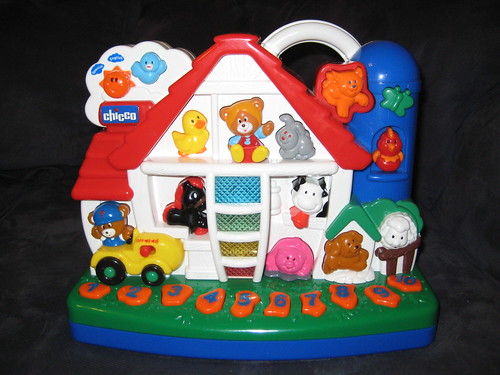
One of the children was utterly cheerful because there was an animal farm sounds toy which she hated and finally she could open it up and hopefully, make something else out of it.


She started by saying that she had never done this before, and that it was the first time she was ever opening up a toy.


Den hag'cker and I were a bit confused how a kid never opened up a toy, something so usual to our childhood. We started questioning why and when did objects became so sacred, far from human touch. A nostalgia trip to our childhood made us recall all the things that we opened up, and messed around. How many radios, toys, broken electric tools, tv remote controls that we 'profaned' while disassembling.


While nostalgia tripping to memory lane, we both started to realize when was it, in the last 20 years that kids stopped opening up electric objects and tweaking them.


We both agreed that, somewhere after the invention (and application to most everyday technological objects) of the microchip, mechanical parts went beyond human touch, due to their reduced size.


The conception of micro, of the barely visible made all those mechanical parts out of touch and out of range from amateur ([French, from Latin amātor, lover, from amāre, to love.]) ability to re-work, and re-cycle, all those mechanical objects.


Towards the end of the 20th century, most things in society started to implode, to become immaterial, invisible and far from being tangible, reducing human agency, the ability to do. I don't remember from who is this quote from (I got it 2nd hand from a friend Mirko Winkel), but I always found it truly revealing: ' if the 20th century was one marked by explosions - of population, of atomic bombs, of information; the 21st century shall be one marked by implosions!'


The question me and Den Hag'cker ended up with was 'how to bring the immaterial back to the realm of the material?', 'how to actually regain 'ability to do' in a sacred world of the object, which abjects the subject?'


After we asked ourselves that, an uncomfortable silence settled in...


gardening & art summer classes


Kt and a summer class of arts and gardening

"Education in the largest sense is any act or experience that has a formative effect on the mind, character or physical ability of an individual. In its technical sense, education is the process by which society deliberately transmits its accumulated knowledge, skills and values from one generation to another."
wikipedia resource

Earlier on our residency we posted an entrance regarding the demolition of the Ferry Pulbic School.
It has become quite clear that to put down a closed school is far less "complex" than having to pay taxes and preserve it.

Dave on a recent talk claimed that his effort to purchase abandoned buildings fell short since they always come with "demolition estimation costs" and demolition practices benefit the state and a small but well protected industry. The so called "demolition prize".

We tend to perceive education to take its most common form under the roof of a school. Living for two months in Detroit we re-discovered diverse educational platforms which focus on passing out skills, enhance mutualism, raise awareness and responsibility, address locality and possibly build an alternative economy practices .
Spread in various "roofs" and initiated by various organizations and individuals these acts respond to the failure of the state to preserve and advance Detroit's educational system.


Wayne State University and University of Detroit Mercy seem to be the only mega foundations promoting Detroit as an educational mecca. On the other hand Universities are just stations in someone's career and therefore embed within the act of temporarily living and subconsciously the act of leaving.

This summer Kt has been teaching art and farming in three locations around Detroit. We "invited ourselves" to her classes and I managed to attend her last teaching sessions in two of the locations.
We came up with a game of drawing your favorite fruit or vegetable
on a paper ribbon, mixing the ribbons and pass them on as "hats" to every one participating. Each kid had to make four questions in order to guess what fruit or vegetable he/she was.
While still difficult to prevent children from looking at their "hats" the game focused on working on the right questions such as:
am i a fruit?
do i grow in our garden?
do i grow above ground?
do i grow on a tree?
am i yellow?
am i round?
etc.


The process of discovering could help them identifying with the object, break it down in forms and shapes, understand the value of the process of growing (gardening) and playfully perform a dialogue of passing out knowledge without the authoritarian overview of the teacher.
Everyone would hold the responsibility of sharing a common set of knowledge (the secret of what is on their friend's hat) and as a unity, by simply answering with a yes or a no could transcend that knowledge to the individual making the questions.


While talking to Joao about our experience, he brought up the term homo ludens introduced by Dutch historian and cultural theorist Johan Huizinga.


Huizinga does not mean that “play turns into culture”. Rather, he sets play and culture side by side, talks about their “twin union”, but insists that “play is primary”.

wikipedia resource